

Michael Murray Managing Director, Murray Property · 22+ years in property management across Darlinghurst & Surry Hills

The NSW rental law changes in September 2026 affect how landlords and property managers respond when a tenant is experiencing domestic abuse. From 21 September 2026, there are new or strengthened rules for ending a tenancy, notifying co-tenants, handling rent and bond issues, protecting sensitive information, changing locks and using photographs of an occupied property.
For a Sydney landlord, the most important point is that a domestic abuse termination notice needs a careful, prompt response. The tenant may be able to leave immediately without a break fee. The landlord or agent then has a separate duty to notify the remaining co-tenants within a specified period, while keeping the tenant’s evidence confidential.
Another rental reform passed NSW Parliament in late September concerns applicants’ personal information and misleading property images. That package is expected to start in early 2027; it is not part of the changes already in force. This guide separates the two so owners and agents can prepare appropriately.
At a glance: what applies now?
| Topic | Position as at 28 September 2026 |
|---|---|
| Domestic abuse tenancy reforms | In force from 21 September 2026 across NSW |
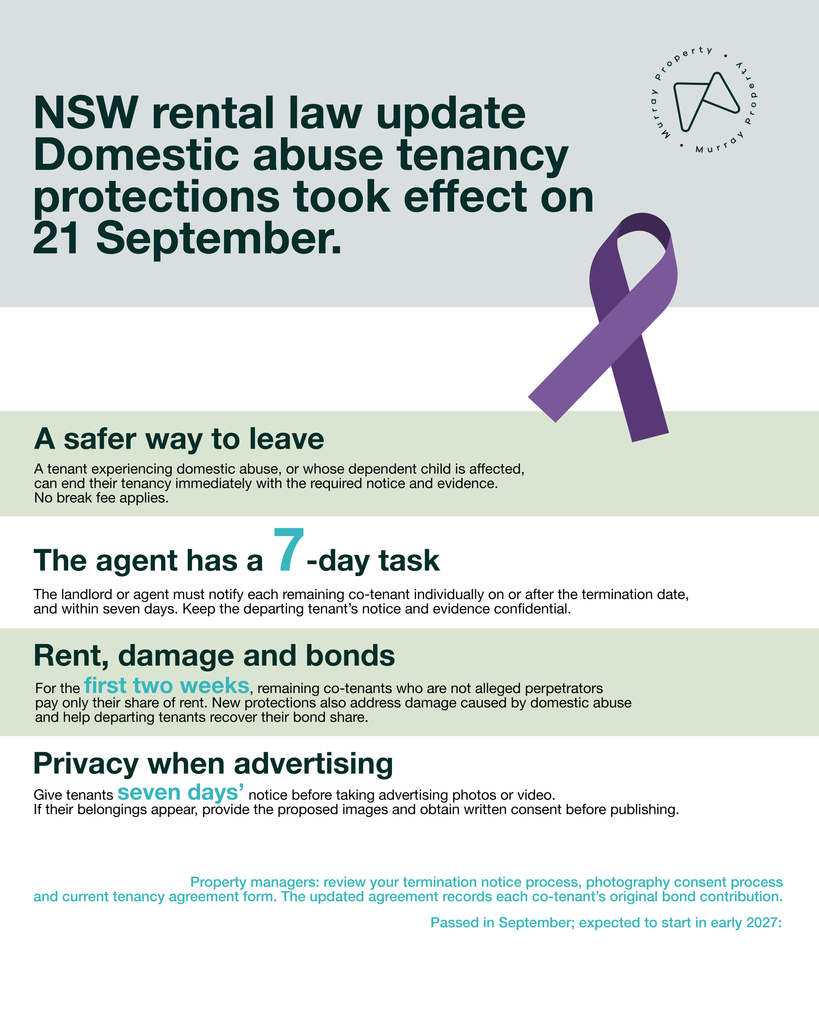
| Co-tenant notification | Landlord or agent gives each remaining co-tenant an individual notice using the approved form, on or after the termination date and within seven days after it |
| Temporary rent adjustment | Eligible remaining co-tenants pay only their share for the first two weeks after the departing tenant’s tenancy ends |
| Rental privacy and application bill | Passed Parliament in September; Government expects the new rules to start in early 2027 |
NSW Fair Trading’s rental law changes timeline confirms the 21 September commencement. Earlier reforms covering no-grounds termination, pets, annual rent increases and payment options began on other dates; they are not new September obligations.
What does “domestic abuse” mean under the rental changes?
The tenancy provisions now use domestic abuse, a term that better reflects harmful behaviour beyond physical violence. It can include coercive or controlling behaviour, financial abuse, intimidation, stalking and other behaviour within a domestic relationship. It does not have to be a criminal offence. NSW Fair Trading explains the meaning of domestic abuse in rental situations.
The official document for ending a tenancy is still called a Domestic Violence Termination Notice. A tenant can use it when they, or their dependent child, are experiencing domestic abuse and provide one of the accepted forms of evidence. The widened list of people who can make a supporting competent person declaration includes certain health practitioners, social workers, counsellors, legal practitioners and prescribed employees of eligible services. A police report is not the only route to obtaining evidence. NSW Fair Trading lists the evidence and competent-person categories.
1. A tenant can end the tenancy without a break fee
An affected tenant may set the termination date as the day the notice is given or a later date. There is no minimum notice period, break fee or other cost associated with ending the tenancy early in these circumstances. The notice must be accompanied by accepted evidence, such as a relevant domestic violence order, a qualifying injunction, a certificate of conviction or a competent person declaration.
When the notice arrives, the landlord or agent should check that the required notice and evidence have been supplied and that the forms relate to the tenancy. The agent is not required to investigate whether domestic abuse occurred. NSW Fair Trading says agents should not seek extra evidence of the abuse, contact the alleged perpetrator or delay the process while trying to verify the account. See its guide to receiving a Domestic Violence Termination Notice.
For owners, this may feel different from an ordinary fixed-term break lease. It is a specific statutory pathway with its own notice, evidence, confidentiality and rent rules. It should be handled on that basis, rather than by applying the usual break-fee schedule.
2. The landlord or agent now notifies remaining co-tenants
The departing tenant does not have to tell their co-tenants that they are ending their part of the tenancy. Once the landlord or agent receives the termination notice, they must notify each remaining co-tenant individually, using the approved co-tenant notice form.
The notice must be given on or after the termination date specified by the departing tenant, and no later than seven days after that date. It must explain the temporary rent adjustment that applies to eligible remaining co-tenants. The landlord or agent must not give co-tenants the original termination notice, the supporting evidence or information from those documents that they are not authorised to receive.
This makes internal handling important. Limit access to the documents, record the termination date and notification deadline, and use the approved form rather than forwarding the tenant’s email or attachments. NSW Fair Trading also requires sensitive documents to be stored and disposed of securely. Its landlord and agent guide sets out the notification and confidentiality duties.
3. How does the two-week rent adjustment work?
For the first two weeks from the termination date, remaining co-tenants who are not identified as the alleged perpetrator only need to pay their own share of the rent. They do not have to cover the departing tenant’s share during this period. A remaining co-tenant identified as the alleged perpetrator in the supporting evidence does not receive that protection and may be responsible for the balance.
NSW Fair Trading’s calculation starts with the total rent divided by the number of tenants before the person left.
For example, if four tenants paid $1,000 per week and one leaves under a Domestic Violence Termination Notice, each protected remaining co-tenant pays $250 per week during the two-week adjustment. If all three remaining tenants qualify, the total collected from them is $750 per week during that period. Different calculations apply to the balance where a remaining co-tenant is identified as the alleged perpetrator.
The notice to each remaining co-tenant must state both the total rent payable by the remaining tenants during the adjustment period and the maximum amount payable by the individual receiving it. An agency should update its rent ledger and check whether any co-tenant has already overpaid before the notice was processed. NSW Fair Trading provides calculations and examples.
4. Damage, bond shares and updated tenancy agreements
A tenant who was not the perpetrator is not responsible for property damage caused by domestic abuse. That protection also applies to non-perpetrator co-tenants, whether the person who caused the damage was a co-tenant, another occupant, a guest or someone else. If the cause of damage is disputed, the NSW Civil and Administrative Tribunal (NCAT) can assess the evidence. It is important to establish the facts before assigning a repair cost or proposing a bond deduction.
When one co-tenant leaves and others remain, the departing tenant can ask the remaining co-tenants for their bond share. NSW Fair Trading says the remaining tenants must pay within 14 days of the request, subject to permitted deductions such as rent owed or other reasonable property costs. If it is unsafe to make that request or there is a dispute, the departing tenant can apply to NCAT for an order about the bond shares. The application must be made within six months after the tenancy ends.
The current NSW standard tenancy agreement, updated on 21 September 2026, records each co-tenant’s original bond contribution for new agreements. That record may help resolve a later dispute about who contributed what. See NSW Fair Trading’s explanation of damage and bond protections.
5. Locks and tenancy database records need careful handling
The changes also expand circumstances in which an affected tenant may change a lock or other security device without the landlord’s prior consent. Examples include where a co-tenant or occupant is prohibited from entering under a relevant order or bail or parole condition, or where an alleged perpetrator who is not a co-tenant poses a qualifying safety risk. Generally, a locksmith or another appropriately qualified person must do the work, with exceptions for an emergency, an NCAT order or impracticability. A tenant who changes a lock without agreement must normally provide the landlord a new key within seven days and other co-tenants a key within 48 hours, except a person legally barred from the property; other agreed or Tribunal-authorised arrangements can apply. Owners should assess the situation against NSW Fair Trading’s lock and security guidance, rather than assume every change requires ordinary prior approval.
Landlords and agents must also check any proposed tenancy database listing. A tenant cannot be listed if they ended their tenancy due to domestic abuse or provide evidence that they were affected by abuse during the tenancy. If such a tenant asks for an existing listing to be removed, the landlord or agent must write to the database operator within seven days requesting removal. NSW Fair Trading’s tenancy database guide explains the process.
6. New rules for photos and video of an occupied rental
The September changes also matter when an occupied rental property is photographed or filmed for a sale or leasing advertisement. They are particularly important where a tenant’s belongings, or a dependent child’s belongings, could appear in the images.
Before taking advertising photographs or video, give the tenant at least seven days’ notice and a reasonable opportunity to move, cover or remove personal items. Entry for this purpose is restricted to the relevant 28-day period before the property is first advertised or the tenancy ends, and generally only one entry for this purpose is allowed in that period.
If the proposed images show personal belongings, the landlord or agent must give the tenant copies free of charge and obtain written consent before publication. This applies to interior and exterior images, including items in outdoor areas or visible through a window. Each affected tenant should consent to images showing their own possessions or those of their dependent child. Consent must be sought for the relevant campaign and not more than three weeks before it starts; if the tenant does not respond within seven days, consent is treated as refused. A tenant may have grounds to refuse where publishing the images could expose them or a dependent child to domestic abuse.
Existing images without visible belongings, photographs taken after the property is vacant, or carefully redacted images may provide alternatives. Any published image must still present the property truthfully. NSW Fair Trading’s advertising guidance and its photo-consent guide cover these requirements.
In suburbs such as Darlinghurst and Surry Hills, owners often need to coordinate leasing photography in occupied apartments or terraces. The timing and consent process should be planned before booking the photographer, rather than assumed to be covered by a general entry notice.
What should Sydney landlords and property managers do now?
The most useful response is a clear process that protects the tenant and gives staff the right dates and documents to work from:
- Use current forms. Check the September 2026 standard tenancy agreement, the Domestic Violence Termination Notice process and the approved form for notifying remaining co-tenants.
- Set a confidential response route. Restrict access to the notice and evidence, avoid forwarding them to co-tenants, and make sure only authorised staff handle them.
- Track deadlines. Record the termination date, the seven-day co-tenant notification deadline and the first two weeks of adjusted rent.
- Check the ledger and bond records. Calculate eligible co-tenants’ shares, correct overpayments where needed and record each tenant’s original bond contribution in new agreements.
- Review photography workflows. Build in notice, a chance to remove belongings, image review and written consent before publishing an occupied property’s listing photos.
- Review safety and database requests individually. Lock changes, damage claims and tenancy database entries can require a different response where domestic abuse is involved.
An experienced manager should know the legal steps and also handle a sensitive situation without requiring the tenant to repeat details unnecessarily. The rules apply across NSW; a Darlinghurst apartment and a Surry Hills terrace are subject to the same tenancy law.
What is coming in 2027 for rental applications and advertising?
On 25 September 2026, the NSW Government announced that Parliament had passed a separate bill covering renters’ personal information and misleading rental advertisements. The Government expects those changes to commence in early 2027; the final application form and some document-handling details are still being settled.
The announced measures include a standardised rental application form, limits on unnecessary information requested from applicants, later collection of ID documents from the preferred applicant, rules for storing and destroying personal information, disclosure of embedded utility networks, and disclosure where digitally altered or AI-generated rental images hide faults or misrepresent the property. These are sensible areas for an agency to review now, but they should not be presented as rules that commenced on 21 September 2026. See the NSW Government announcement.
—
Disclaimer
The data, figures, and market statistics referenced in this article were current at the time of publication and are sourced from third-party providers including CoreLogic/Cotality, Domain, realestate.com.au, HtAG Analytics, PropTrack, and NSW Fair Trading, among others. Property market data changes frequently, median prices, rental yields, vacancy rates, clearance rates, and days on market figures are updated regularly by their respective providers and may have changed since this article was published. Readers are encouraged to verify all figures directly with the cited sources before making any decisions.
This article is intended as general information only. It does not constitute financial, investment, legal, or taxation advice. The information provided does not take into account your individual circumstances, objectives, financial situation, or needs. Before making any property investment, purchase, sale, or management decision, you should seek independent advice from a qualified financial adviser, solicitor, or property professional licensed in your state.
Murray Property is a licensed real estate agency operating in NSW. We are not financial advisers. References to rental yields, capital growth, or investment returns are based on publicly available market data and historical performance, which is not a reliable indicator of future results.
© Murray Property. All rights reserved. Reproduction of this content without written permission is prohibited.