

If you own an apartment in Paramount (1–7 Pelican Street), Monument (20 Pelican Street) or Madison (28 Pelican Street), you’re holding property in one of the most concentrated pockets of high-amenity apartment towers anywhere in Surry Hills. All three sit within a couple of hundred metres of each other, facing Harmony Park, a short walk from Oxford Street, Hyde Park and the CBD, right on the boundary where Surry Hills meets Darlinghurst, and all three have built strong, long-standing tenant demand over the past two decades. But each building has its own quirks, by-laws and management realities that a generic property manager can easily miss.
This is a companion piece to the guide we wrote on Manhattan and Oasis on nearby Poplar Street, because the same principle applies here: owning in a well-amenitised, tightly held tower is a genuinely different management challenge to owning a standalone terrace, and it rewards a property manager who actually knows the building, the block, and the street it sits on.
A pocket of Surry Hills with more history than it looks
It’s easy to walk past Harmony Park, the strip of green that Paramount and Madison both face directly, and that sits a short stroll from Monument, without knowing quite how much has happened on that patch of ground. The story is worth knowing, because it says something real about the character of this whole neighbourhood.
Surry Hills as a place-name dates back to 1792, when NSW Corps paymaster Captain Joseph Foveaux received a 100-acre land grant just south of what were then the limits of Sydney town. The area stayed largely undeveloped until the Riley Estate was broken up in the 1840s, at which point streets including Foveaux and Riley were cut through what had originally been shifting sand hills. What followed was rapid, dense development, mostly narrow Victorian terraces, and within about fifty years, the suburb had slid from a promising new estate into serious overcrowding. By 1905, the Sydney Municipal Council had begun a program of slum clearance, using road widening as part of the justification. One of the first streets cleared was Wexford Street, which had housed a large concentration of Sydney’s Chinese community.
The specific ground beneath Harmony Park was part of a later chapter of that same clearance story: a Brisbane Street resumption in the 1920s. The state government formally bought the site in 1954 and, for decades afterwards, it served fairly unglamorously as a car park, with the Sydney Police Centre and an electricity substation eventually built on an adjoining portion. It wasn’t until 2001 that the City of Sydney bought back the remaining land with the intention of creating a proper park, and it opened in 2006, first informally known as Surry Hills Park, then officially renamed Harmony Park in recognition of the site’s layered history and the cultural and social diversity of Surry Hills and Darlinghurst. A nice detail for anyone who walks their dog there today (it’s an off-leash area): the park is watered by stormwater harvested from the roof of the neighbouring electricity substation, into a 240,000-litre tank.
None of that history changes anything about buying or renting an apartment on Pelican Street today. But it’s a useful reminder that this part of Surry Hills has been through more than one complete transformation, from sand hills, to slum, to industrial car park, to one of the more culturally significant small parks in the inner city, and the apartment towers now surrounding it are simply the latest chapter in a street that has never stayed the same for very long.
What it’s actually like living here today
Whatever era of Surry Hills history you’re standing in, the practical draw of this exact pocket hasn’t changed much: it sits right where Surry Hills meets Darlinghurst, with the best of both suburbs within easy walking distance.
Monument itself sits almost directly above Oxford Square, a small shopping centre on Oxford Street that marks the informal border between the two suburbs. From any of the three buildings, Oxford Street’s Darlinghurst strip is a five-to-ten-minute walk, home to one of Sydney’s most storied entertainment precincts. This stretch has been the heart of Sydney’s LGBTQIA+ nightlife for decades, and it’s where the Sydney Gay and Lesbian Mardi Gras began life as a civil rights march in 1978, before growing into one of the world’s largest annual parades. Live music and theatre are woven through the same few blocks, the Oxford Art Factory for gigs, the Griffin Theatre Company at the historic SBW Stables Theatre, and the heritage-listed Eternity Playhouse on Burton Street. More recently, the Oxford and Foley precinct, a major redevelopment spanning 60–120 Oxford Street, has been reinvigorating this exact strip with new dining, retail and a boutique hotel, adding fresh energy to a street that, as anyone who’s followed Sydney’s hospitality scene knows, has never really stopped being a destination.

Walk the other direction and you’re in classic Surry Hills territory: Crown Street, generally regarded as the heart of the suburb’s café and restaurant culture, along with a genuinely dense concentration of independent boutiques and homewares stores. Harmony Park itself, right on these buildings’ doorstep, hosts a steady stream of local life, an off-leash dog park by day, with Prince Alfred Park and its own Surry Hills Festival a little further south for anyone wanting more green space. Hyde Park is a similarly short walk in the other direction, and Museum Station puts the CBD only a few minutes away by train, with the Surry Hills light rail stop just outside the suburb’s western boundary for anyone heading further afield.
It’s this specific combination, genuine walkability to two distinct lifestyle precincts, tucked behind three well-established residential towers, that keeps tenant demand for Paramount, Monument and Madison consistently strong, regardless of what the broader Sydney market is doing in any given quarter.
Paramount, 1–7 Pelican Street
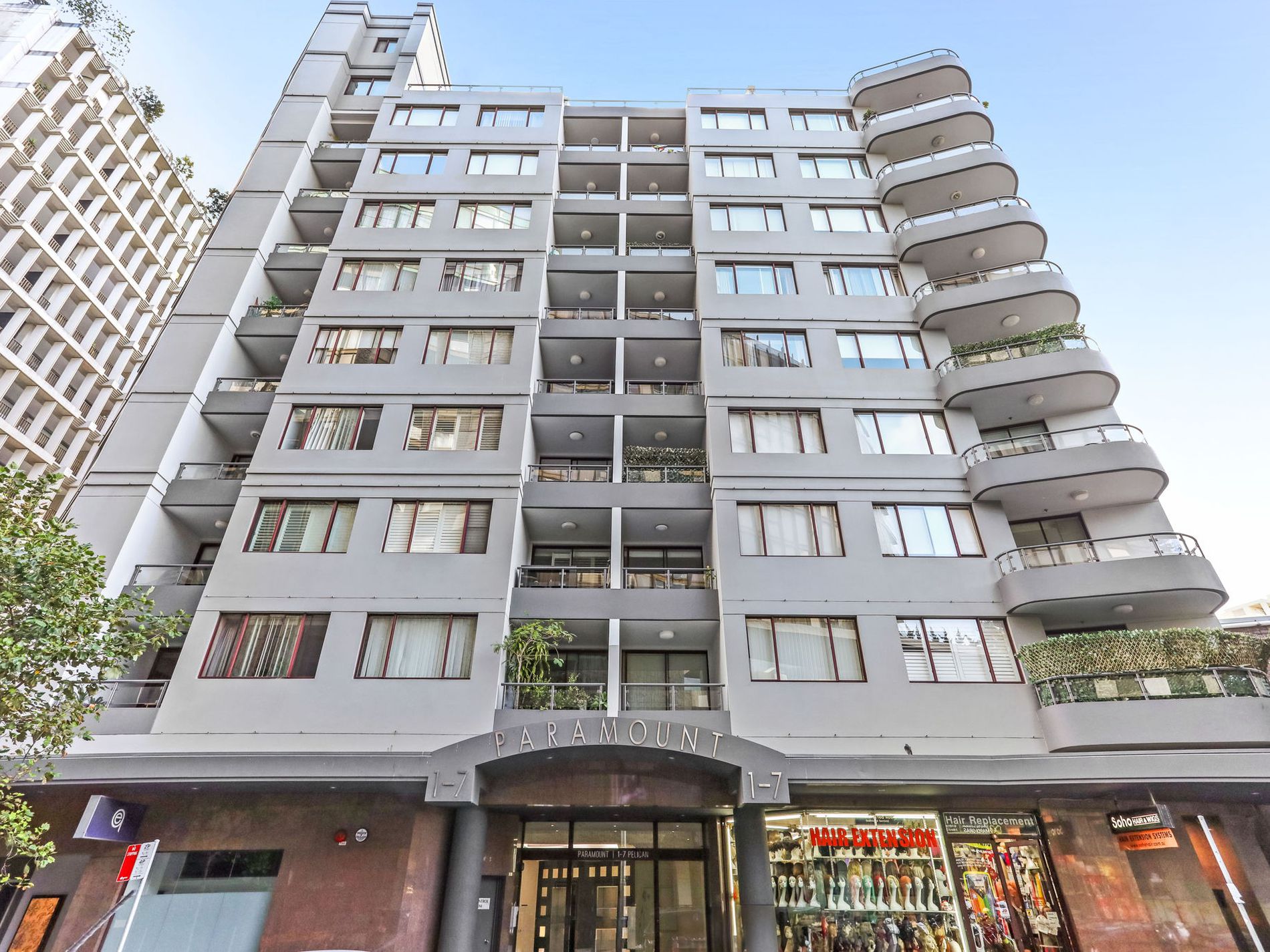
Paramount is a high-rise tower directly opposite Harmony Park, with apartments extending to at least the 11th floor and a mix of one, two and three-bedroom layouts, including sub-penthouse and split-level configurations. It’s consistently marketed toward “executive style” tenants, and the building’s amenity offering supports that positioning: a heated 20-metre indoor pool, spa, sauna, and gymnasium, plus a rooftop terrace with BBQ facilities. There’s an on-site building manager, secure basement parking, storage cages, and intercom-controlled lift access.
A snapshot of outgoings, drawn from a past listing on a one-bedroom apartment: strata levies of roughly $1,333 per quarter, council rates around $174 per quarter, and water rates near $145 per quarter. As with any strata figures, these will vary by lot size, floor level and the building’s current budget, and should be confirmed directly with the strata manager for a specific apartment.
What this means for owners: Paramount’s resort-style amenity, indoor pool, spa and sauna in particular, is a genuine point of difference even among Surry Hills’ amenity-rich towers, and it supports a premium executive tenant pool when a property is priced and presented correctly. The building’s popularity with corporate tenants also means presentation expectations run high; an apartment that isn’t up to the standard of a well-travelled executive tenant will often sit longer, or lease at a discount to what the building is actually capable of achieving.
Monument, 20 Pelican Street
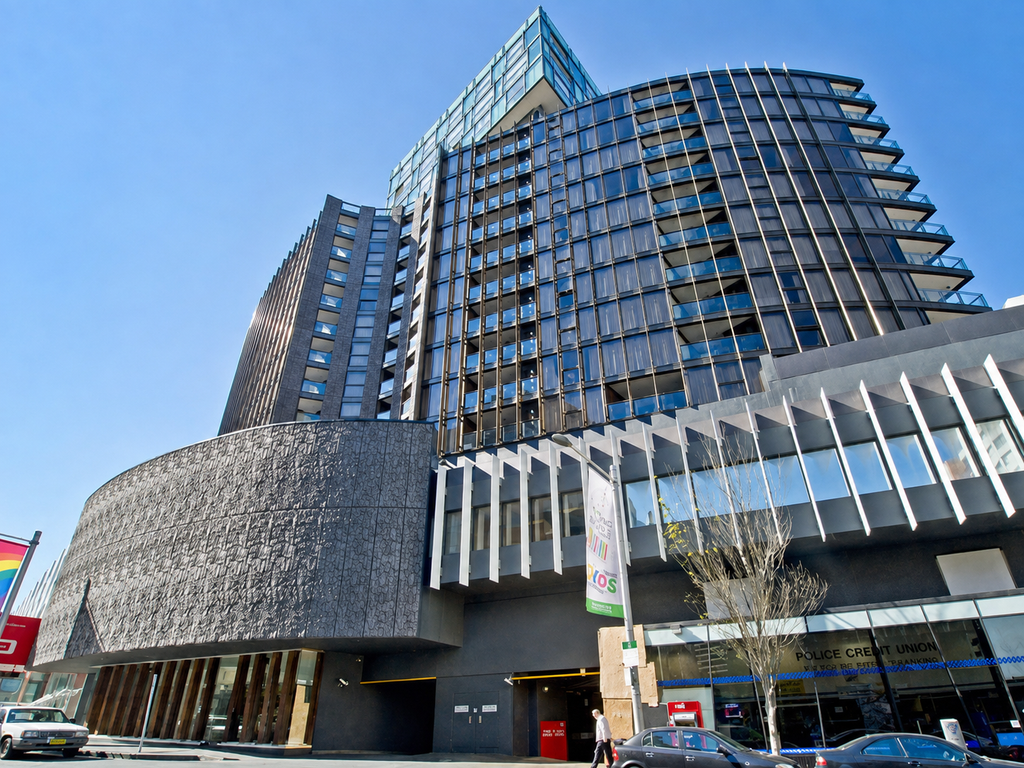
Monument is the architectural standout of the three, and arguably of the whole street. It’s an architect-designed tower by Wood/Marsh Architecture, the award-winning Melbourne firm, known for its full-height, floor-to-ceiling glass facade and apartments with genuine harbour, CBD and Opera House views from the upper floors. Facilities include concierge, a heated outdoor pool with landscaped gardens, a gymnasium, and secure basement parking with storage cages, all within 200 metres of Hyde Park and sitting almost directly above Oxford Square, right on the Surry Hills–Darlinghurst boundary.
A snapshot of outgoings from a past listing: water rates around $720 per year, council rates around $1,067 per year, and strata levies around $1,716 per quarter, noticeably higher than the other two buildings, which is consistent with a more amenity-heavy, architecturally ambitious scheme.
What this means for owners: Monument’s biggest differentiator, its full-height glass architecture, comes with real management implications that aren’t obvious from the outside. More on that below, because it’s a genuinely useful example of the kind of building-specific knowledge that matters here.
Madison, 28 Pelican Street
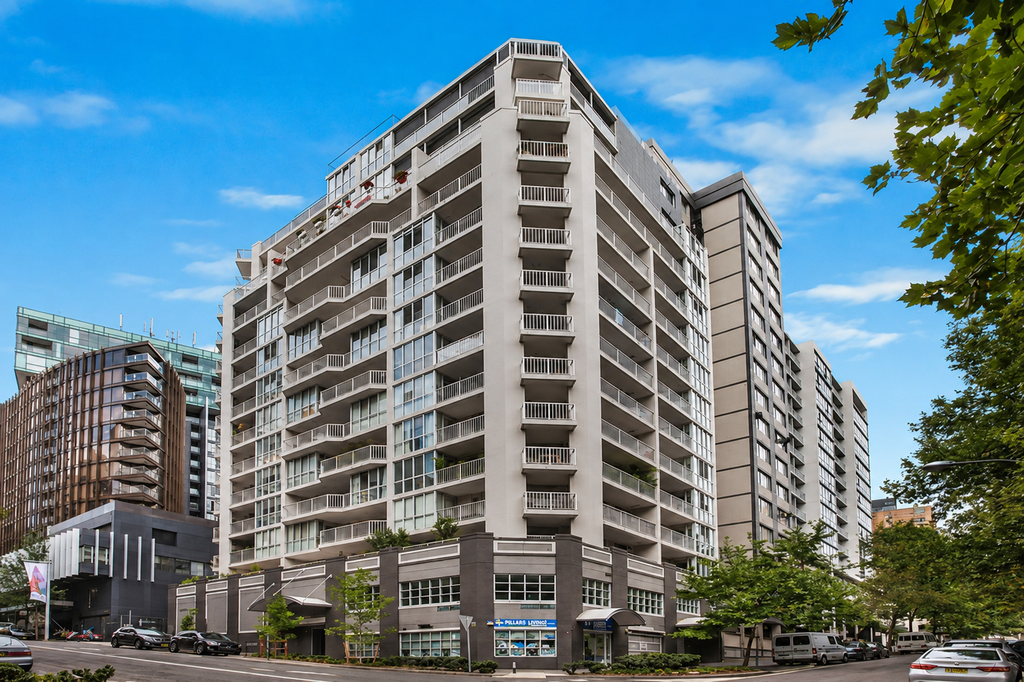
Madison sits opposite Harmony Park and around 50 metres from Oxford Square, with apartments extending to at least the 11th floor. It’s a more understated building than its two neighbour, security access, lift, gymnasium and sauna, but without the pool and concierge offering of Paramount or Monument. That makes it a slightly different proposition for owners: still a well-located, well-built tower in a premium pocket of Surry Hills, but competing on location and value rather than resort-style amenity.
A snapshot of outgoings from a past sale listing (70 sqm apartment): water rates around $184.54 per quarter, council rates around $308.60 per quarter, and strata levies around $1,642.38 per quarter.
What this means for owners: Because Madison doesn’t carry the same amenity premium as Paramount or Monument, pricing and presentation matter proportionally more. Tenants comparing Madison against its two Pelican Street neighbours are often comparing purely on price, location and apartment condition, which means a property manager who prices to the specific unit’s outlook, floor and condition, rather than a flat suburb average, makes a real difference to time-on-market here.
A real example: what can slip through the cracks even in a well-run building
Monument’s own building management publishes resident guidelines that are worth every owner in the building knowing about, because they’re the kind of detail that rarely surfaces until someone breaches them.
The first is a specific by-law, special by-law No. 4 that prohibits short-term letting of less than three months’ duration, explicitly including platforms like Airbnb. This isn’t a general council rule; it’s a building-specific by-law, and a breach of it can also put a standard residential tenancy agreement at risk. An owner who isn’t aware of this, or a property manager who doesn’t check building-specific by-laws before setting up a lease, could unknowingly create a compliance problem.
The second is more unusual: because of Monument’s full-height glass design, the building’s original architects, Wood/Marsh, provided specific guidance that the building’s management now enforces as strict guidelines around window coverings. This is a genuinely building-specific quirk, the kind of thing that only surfaces if a property manager has actually read the building’s own guidelines, rather than applying a generic approach to blinds and curtains across every property in a portfolio.
Neither of these is a criticism of Monument or its management, if anything, having clear, published guidelines is a sign of a well-run building. But it’s a useful illustration of exactly the kind of detail that separates a property manager who genuinely knows a building from one who’s managing it the same way as every other listing in their portfolio.
Where we focus for owners in these buildings
This is where we think property management earns its keep for owners across Paramount, Monument and Madison specifically:
Knowing each building’s specific by-laws before a lease is signed, not just the standard strata by-laws every scheme carries, but building-specific rules like Monument’s short-term letting prohibition or window covering guidelines, which can catch out both owners and tenants if nobody checks.
Knowing each building’s specific by-laws before a lease is signed, not just the standard strata by-laws every scheme carries, but building-specific rules like Monument’s short-term letting prohibition or window covering guidelines, which can catch out both owners and tenants if nobody checks.
Pricing to the specific outlook and amenity mix, not a flat “Pelican Street” average. A pool-and-concierge apartment in Paramount or Monument, a view apartment in Monument, and a well-located but simpler unit in Madison are three different value propositions, and treating them identically in a rental appraisal leaves money on the table or risks an extended vacancy.
Coordinating properly with on-site building managers and concierge teams, particularly in Paramount and Monument, rather than assuming they’ll handle every issue on an owner’s behalf without follow-up from the managing agent.
Routine inspections that check amenity-adjacent details, storage cage use, car space condition, whether shared facilities like pools and gyms are functioning as advertised to the tenant, since these buildings are specifically marketed and let on the strength of that amenity.
Being the buffer for owners who aren’t local. As with most amenity-rich inner-city towers, a meaningful share of investors across these three buildings live interstate or overseas, and benefit from a property manager who’s genuinely on the ground in this exact pocket of Surry Hills.
Understanding the tenant pool this exact location attracts. Sitting between Oxford Street’s nightlife and hospitality precinct and Crown Street’s café culture, these three buildings tend to draw tenants who specifically want walkable access to both, a different profile to a quieter, more residential Surry Hills address, and worth reflecting in how a property is marketed.
Considering a change in property manager?
If you own in Paramount, Monument or Madison and you’re not confident your current property manager actually knows the building’s specific by-laws, amenity mix and tenant pool, rather than treating your apartment like any other listing in their portfolio, it’s worth a conversation. We manage rental properties throughout Surry Hills, Darlinghurst and Sydney’s Eastern Suburbs, including the Pelican Street and Poplar Street towers specifically, and we’re on the ground in this exact pocket regularly.
You can find out more about how we manage rental properties, including how we handle strata and by-law compliance, maintenance, and tenant selection, on our property management page. If you’re also weighing up how these buildings compare to nearby Manhattan and Oasis on Poplar Street, our guide to those two buildings is a useful companion read.